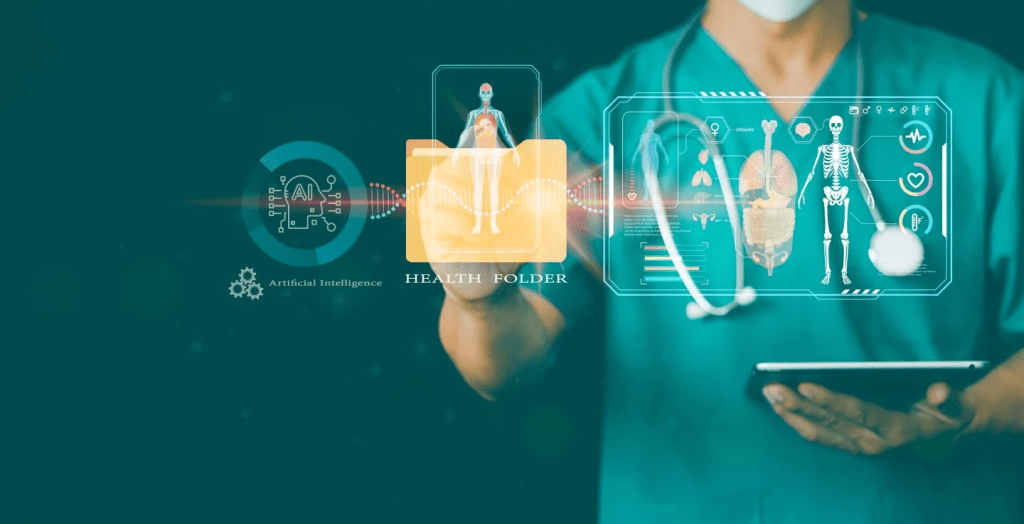
Advancements in technology have revolutionized the healthcare sector in recent years, with artificial intelligence (AI) emerging as a game-changer. Among the many AI applications in healthcare, generative AI stands out as a powerful tool that holds immense promise. This article explores the role of generative AI in healthcare and its potential to reshape the way we approach medicine.
The Power of Generative AI
Generative AI, a subset of artificial intelligence, involves creating new content, such as images, text, or even medical data, from existing information. This technology leverages algorithms, particularly deep learning models like Generative Adversarial Networks (GANs) and Variational Autoencoders (VAEs), to generate data that is remarkably similar to what it was trained on. The ability to create novel data sets has wide-ranging applications in healthcare, ranging from drug discovery to patient care.
Drug Discovery and Development
One of the most exciting areas where generative AI is making a substantial impact is drug discovery. Developing new medications is a costly and time-consuming process, but generative AI can expedite it significantly. By analyzing vast datasets of chemical compounds and their interactions, generative AI can predict and generate potential drug candidates. This not only reduces the time required for development but also minimizes the need for extensive laboratory testing, making drug discovery more efficient and cost-effective.
Medical Imaging and Diagnosis
Generative AI has also proven to be a valuable tool in the realm of medical imaging. It can be used to enhance and interpret images, improving the accuracy of diagnosis. For instance, generative adversarial networks can reconstruct higher-resolution images from lower-resolution inputs, aiding radiologists in identifying subtle abnormalities that may have otherwise gone unnoticed. Additionally, AI-powered image generation can simulate various medical conditions, helping medical professionals train and prepare for complex surgical procedures or rare cases.
Personalized Treatment Plans
Every patient is unique, and generative AI can contribute to the development of personalized treatment plans. By analyzing a patient’s medical history, genetics, and other relevant data, generative models can generate treatment options that are tailored to an individual’s specific needs. This ensures that patients receive the most effective and appropriate care, reducing the risk of adverse reactions and enhancing overall treatment outcomes.
Natural Language Processing in Healthcare
Natural language processing (NLP) is a branch of generative AI that deals with the interaction between computers and human language. In healthcare, NLP is invaluable for processing and extracting information from medical records, research papers, and clinical notes. These technologies can generate structured data from unstructured text, making it easier for healthcare providers to access and analyze patient information.
Telemedicine and Remote Monitoring
The rise of telemedicine and remote patient monitoring has been accelerated by generative AI. Chatbots and virtual assistants powered by generative AI can interact with patients, answer their questions, and collect relevant medical information. These systems also support remote monitoring, helping healthcare professionals keep track of patients’ vital signs and symptoms. By providing real-time feedback and alerts, generative AI ensures timely interventions and improved patient care, even from a distance.
Challenges and Ethical Considerations
While generative AI holds great promise in healthcare, it is not without challenges and ethical concerns. Ensuring data privacy and security is paramount, as healthcare data is highly sensitive. Additionally, the black-box nature of some AI models can make it difficult to explain the rationale behind their decisions, which could lead to mistrust among healthcare professionals and patients. Striking the right balance between automation and human expertise is crucial to maintain the integrity of medical practice.
The Future of Healthcare
Generative AI is already making a substantial impact on healthcare, and its role is set to expand in the future. As AI algorithms continue to improve and more healthcare organizations adopt this technology, we can expect several transformative developments:
- Faster Drug Discovery: The development of new medications will become more efficient and cost-effective, leading to a quicker response to emerging health threats.
- Enhanced Diagnostics: AI-powered medical imaging and diagnostic tools will become more accurate and accessible, improving early disease detection.
- Personalized Medicine: The adoption of generative AI will lead to a shift from one-size-fits-all treatments to personalized and more effective care plans.
- Efficient Healthcare Delivery: Telemedicine and remote monitoring will become standard practice, increasing accessibility and reducing the burden on healthcare facilities.
- AI-Enabled Research: Generative AI will assist researchers in analyzing vast amounts of medical data, potentially uncovering new insights and breakthroughs.
In Conclusion
Generative AI is a transformative force in healthcare, revolutionizing drug discovery, diagnostics, patient care, and research. The power of creating new data from existing information is paving the way for more efficient and personalized healthcare. However, it is crucial to address challenges related to data privacy, transparency, and ethics as we embrace this technology. The future of healthcare is AI-driven, and generative AI is at the forefront of this exciting transformation, promising better outcomes and improved patient experiences.
 Archie Evans Tech